What Is SI Joint Fusion?
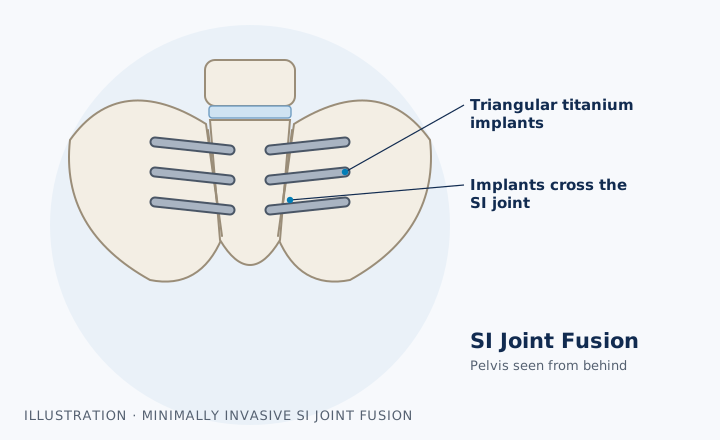
SI joint fusion treats confirmed sacroiliac joint pain by placing implants — typically titanium rods or threaded implants — across the joint to eliminate the small amount of motion that's generating pain, while the joint fuses solid over time. It addresses SI joint dysfunction whether it developed on its own or as a secondary effect of altered mechanics after a prior lumbar fusion.
Who It's For
Candidates have a clinical presentation consistent with SI joint pain, have failed an adequate trial of conservative treatment — physical therapy, activity modification, anti-inflammatory medication — and have had significant, reproducible relief from a diagnostic injection into the joint. This confirmatory injection is essentially a requirement before surgery is considered, since it distinguishes true SI joint pain from pain referred from elsewhere in the spine.
How the Procedure Is Performed
Through one or two small incisions, implants are placed across the SI joint under fluoroscopic (live X-ray) guidance, typically using a lateral or posterior approach depending on anatomy and implant selection. The goal is precise placement across the joint to immediately reduce painful motion, with bone healing across and around the implants over the following months to create a lasting fusion.
Recovery & Rehabilitation
Many patients go home the same day or after a single overnight stay. Initial weight-bearing restrictions are common for the first several weeks, followed by a gradual return to normal activity guided by physical therapy. Most patients notice a meaningful reduction in their presenting pain relatively early, though full fusion and maximal improvement develop over several months.
Worth Knowing
Dr. Snowden has specific research experience in SI joint and pelvic fixation, including serving as site principal investigator in SILVIA, an international randomized trial of pelvic fixation techniques in long fusions to the pelvis, published in The Journal of Bone and Joint Surgery. See the published results →